Dynamic Enterobactin model
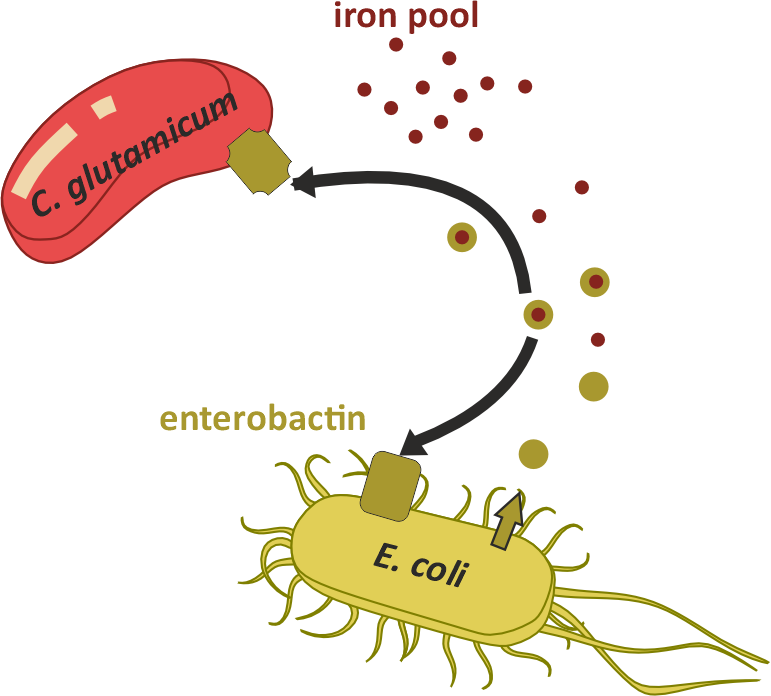
The dynamic enterobactin model describes siderophore-mediated cross-feeding between E. coli and C. glutamicum, developed within the SFB MibiNet community to study how iron competition shapes synthetic microbial communities. Enterobactin is a catecholate siderophore produced only by E. coli under iron limitation; once secreted it chelates ferric iron and can be taken up by both species, so C. glutamicum exploits the iron captured by E. coli without paying the production cost — enterobactin therefore acts as a public good.
The model tracks four state variables — the two biomasses, a shared carbon substrate and extracellular enterobactin — with double-Monod growth kinetics that require both substrate and siderophore simultaneously.
Simulation parameters
Analyses
Time course
Loading chart...
Innoculation ratio scan
Add analysis
Model Details
Review and edit model structure, biological variables, and kinetic parameters.
| Name | Tex name | Initial value | Actions |
|---|---|---|---|
Edit Options
Edit Options
Edit Options
Edit Options
Eq Editor
Build an expression by selecting a node and replacing it with a MathML element, then adjust symbols to the allowed variable names.
Arithmetic
Functions
Trigonometry
Hyperbolic
Comparison
Logic
Tip: click any element to select it, then choose a MathML element above or adjust its value. Click the surrounding canvas to wrap the whole expression in a new element. Drag any element onto another to move it there; Ctrl+Z / Ctrl+Shift+Z undo and redo.
Eq Editor
Build an expression by selecting a node and replacing it with a MathML element, then adjust symbols to the allowed variable names.
Arithmetic
Functions
Trigonometry
Hyperbolic
Comparison
Logic
Tip: click any element to select it, then choose a MathML element above or adjust its value. Click the surrounding canvas to wrap the whole expression in a new element. Drag any element onto another to move it there; Ctrl+Z / Ctrl+Shift+Z undo and redo.
Generated LaTeX Code
\begin{align*}
  \frac{d x1}{dt} &= x1 \cdot \frac{mu\_max1 \cdot p1 \cdot s1}{(K\_s1 + s1) \cdot (K\_s\_X1-P + p1)} \\
  \frac{d x2}{dt} &= x2 \cdot \frac{mu\_max2 \cdot p1 \cdot s1}{(K\_s2 + s1) \cdot (K\_s\_X2-P + p1)} \\
  \frac{d s1}{dt} &= - \frac{x1}{Y\_X1\_S} \cdot \frac{mu\_max1 \cdot p1 \cdot s1}{(K\_s1 + s1) \cdot (K\_s\_X1-P + p1)} \\
  & - \frac{x2}{Y\_X2\_S} \cdot \frac{mu\_max2 \cdot p1 \cdot s1}{(K\_s2 + s1) \cdot (K\_s\_X2-P + p1)} \\
  \frac{d p1}{dt} &= x1 \cdot \frac{mu1 \cdot q\_p1\_max}{mu\_max1} \\
  & - x1 \cdot \frac{mu1 \cdot q\_up\_X1\_max}{mu\_max1} \\
  & - x2 \cdot \frac{mu2 \cdot q\_up\_X2\_max}{mu\_max2}
\end{align*}