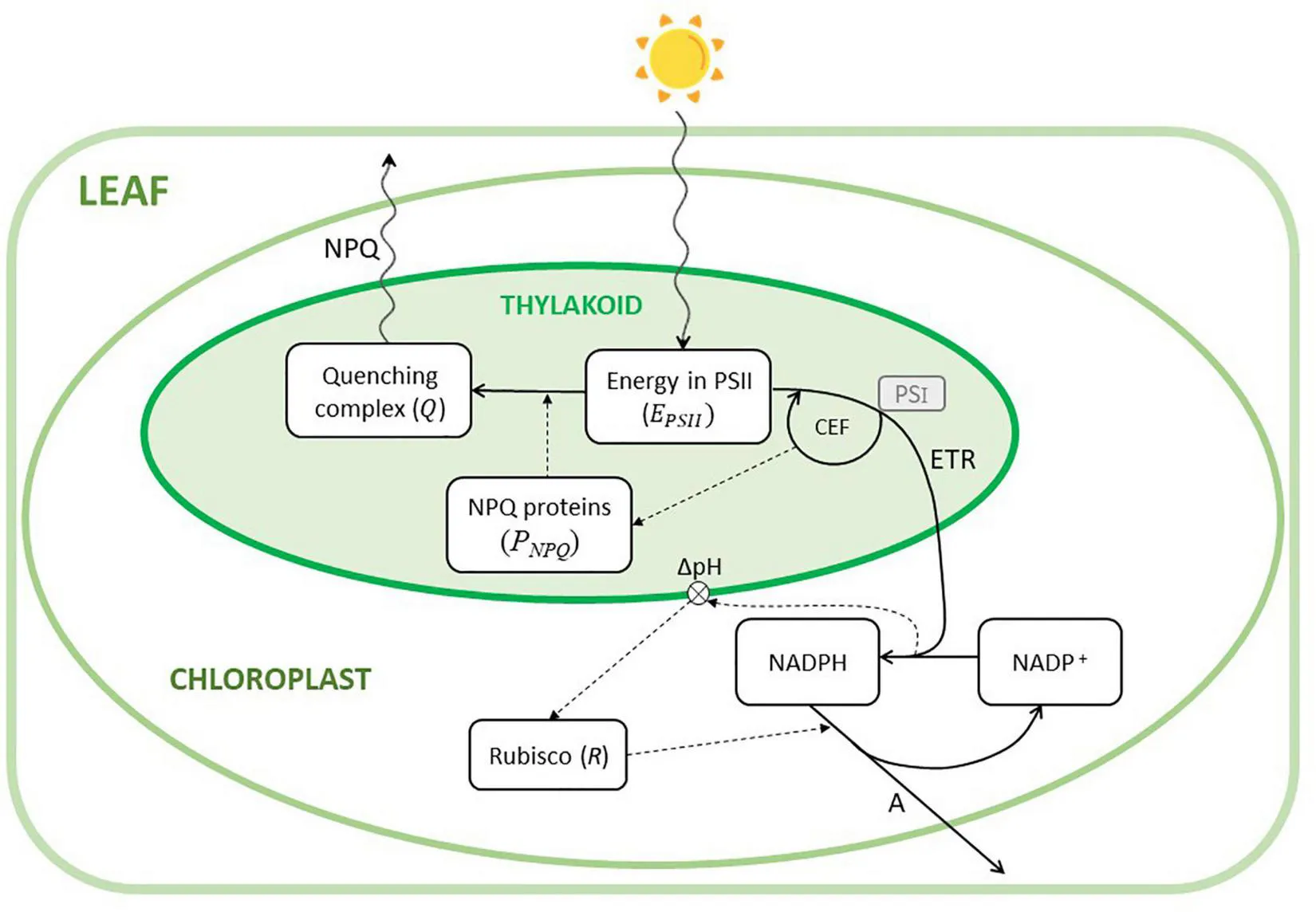
The Salvatori 2022 model — "A System Dynamics Approach to Model Photosynthesis at Leaf Level Under Fluctuating Light" — is a deliberately coarse-grained, system-dynamics description of leaf photosynthesis under changing illumination. Rather than resolving every carrier in the electron transport chain, it lumps the process into just six state variables: the active fraction of photosystem II (PSII), an electron-transport intermediate (Q), the non-photochemical quenching state (P_NPQ), the NADPH/NADP+ redox pool, and the activation state of RuBisCO (R). Incident light drives PSII, electrons flow through the chain to build up reducing power, cyclic electron flow and the resulting transmembrane ΔpH feed ATP production and activate the NPQ machinery, and the NADPH/NADP+ ratio in turn activates RuBisCO, which assimilates CO₂.
The model's goal is to capture the dynamic, leaf-level response of photosynthesis to fluctuating light with as few components as possible, linking the fast photoprotective regulation (NPQ) to the slower activation of carbon fixation. Because it abstracts the light and carbon reactions into a small, transparent set of coupled fluxes, it is included in GreenSloth as a minimal, high-level alternative to the more mechanistically detailed photosynthesis models — useful for illustrating the overall regulatory logic of the system without the complexity of a full kinetic electron-transport chain.