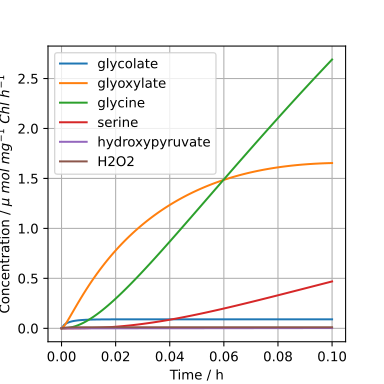
The Yokota 1985 model is a kinetic simulation of the peroxisomal/glycolate branch of photorespiration in C₃ plants and the alga Euglena gracilis. It grew out of the authors' measurement that glyoxylate reacts non-enzymatically with hydrogen peroxide as a second-order reaction (rate constant 2.27 l mol⁻¹ s⁻¹ at pH 8.0, 25 °C), a reaction that had been proposed as a non-enzymatic, decarboxylating source of photorespiratory CO₂. Using this rate constant together with reported Michaelis-Menten parameters for glycolate oxidase, glyoxylate:glutamate/alanine aminotransferase, glycine decarboxylase, serine:glyoxylate aminotransferase, hydroxypyruvate (glycerate) reductase and catalase, the authors built a reaction-kinetic model of the pathway glycolate → glyoxylate → glycine → serine → hydroxypyruvate, with H₂O₂ produced alongside glyoxylate and removed by catalase.
The GreenSloth implementation mirrors this reaction network directly, with each enzyme step given as a Michaelis-Menten (or ping-pong bi-bi, for serine:glyoxylate aminotransferase) rate law and glycolate supplied at a constant rate from phosphoglycolate phosphatase. Simulating the full system let the authors show that essentially all of the H₂O₂ generated during glycolate oxidation is removed by catalase rather than by reaction with glyoxylate, meaning the non-enzymatic glyoxylate–H₂O₂ reaction cannot be a significant CO₂ source under physiological conditions — so photorespiratory CO₂ must instead originate from the glycine decarboxylase step, not from glyoxylate decarboxylation. In Euglena, which has comparatively low catalase activity, the simulation showed the same non-enzymatic reaction becomes fast enough to matter, explaining species-specific differences in glycolate metabolism. Together with Hahn 1987 and Zhu 2009, this model rounds out GreenSloth's photorespiration models, focusing specifically on the downstream glycolate pathway rather than the Rubisco oxygenation step itself.