Zhu 2005, Planta
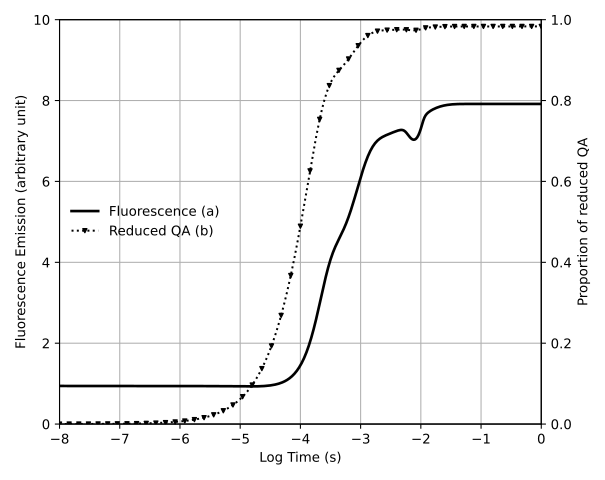
The Zhu 2005 model is a mechanistic kinetic model of Photosystem II (PSII) built to predict the polyphasic O-J-I-P rise of chlorophyll a fluorescence induction that is observed when a dark-adapted leaf is exposed to a pulse of strong actinic light. Rather than fitting the O-J-I-P transient empirically, Zhu, Govindjee, Baker, deSturler, Ort and Long constructed the kinetics from first principles, explicitly resolving every discrete step between the absorption of a photon and the reduction of the plastoquinone (PQ) pool: excitation energy trapping by the reaction centre, primary charge separation and recombination between P680 and pheophytin, forward and back electron transfer from Q<sub>A</sub> to Q<sub>B</sub> (tracking the singly and doubly reduced states of Q<sub>B</sub> separately), and the S-state cycle of the oxygen-evolving complex on the donor side.
PSII heterogeneity is built directly into the model: alongside the Q<sub>B</sub>-reducing reaction centres that carry out linear electron transport, a second population of Q<sub>B</sub>-non-reducing centres is tracked in parallel, itself split into sub-populations with core, peripheral, and fully detached antenna. A connectivity parameter — the "puddle-to-lake" parameter familiar from antenna models — sets how much excitation energy can migrate between neighbouring PSII units before being trapped or dissipated, while a temperature-dependent equilibrium constant governs the reversible charge-transfer equilibrium between the antenna and P680. Fluorescence yield is obtained by summing radiative de-excitation from every excited antenna and reaction-centre pool, so the simulated O, J, I and P phases emerge jointly from the acceptor-side redox states, the donor-side S-state transitions, and the two reaction-centre populations, rather than from any single rate-limiting step.
With around 40 variables and more than 90 reactions, it is by far the most detailed PSII model in GreenSloth, and one of the first to reproduce the complete O-J-I-P transient — including the I-P phase usually attributed to PQ pool reduction and donor-side limitations — from a single, mechanistically grounded parameter set. It is included here as a reference model for chlorophyll fluorescence induction analysis, and as a detailed counterpart to the simpler, NPQ-focused PSII models in the collection, such as Matuszynska 2016.
Analysis
Model definition
Variables
| Symbol | ID | Initial value |
|---|---|---|
| Ap | 0 | |
| U | 0 | |
| P680plus_Pheominus | 0 | |
| P680plus_Pheo | 0 | |
| P680_Pheominus | 0 | |
| S0T | 0.2 | |
| S1T | 0.8 | |
| S2T | 0 | |
| S3T | 0 | |
| S0Tp | 0 | |
| S1Tp | 0 | |
| S2Tp | 0 | |
| S3Tp | 0 | |
| QA_QB | 1 | |
| QAred_QB | 0 | |
| QA_QBred | 0 | |
| QAred_QBred | 0 | |
| QA_QB2red | 0 | |
| QAred_QB2red | 0 | |
| PQH2 | 3 | |
| Aip | 0 | |
| Ui | 0 | |
| Uifc | 0 | |
| P680plus_Pheominus_i | 0 | |
| P680plus_Pheo_i | 0 | |
| P680_Pheominus_i | 0 | |
| S0T_i | 0 | |
| S1T_i | 0 | |
| S2T_i | 0 | |
| S3T_i | 0 | |
| S0Tp_i | 0 | |
| S1Tp_i | 0 | |
| S2Tp_i | 0 | |
| S3Tp_i | 0 | |
| QA_QB_i | 0 | |
| QAred_QB_i | 0 | |
| QA_QBred_i | 0 | |
| QAred_QBred_i | 0 | |
| QA_QB2red_i | 0 | |
| QAred_QB2red_i | 0 |
Parameters
| Symbol | ID | Value |
|---|---|---|
| Iin | 3000 | |
| x | 0 | |
| p | 0.5 | |
| c_light | 300000000 | |
| h | 6.62e-34 | |
| k_boltzmann | 1.38e-23 | |
| temperature | 298 | |
| lambda_chl | 6.73e-7 | |
| lambda_p680 | 6.8e-7 | |
| n_psi_psii | 1 | |
| n_core_chl | 70 | |
| n_nonreducing_peripheral_chl | 220 | |
| n_nonreducing_core_chl | 35 | |
| n_nonreducing_detached_chl | 35 | |
| P680Pheo_total | 1 | |
| PQ_total | 6 | |
| k2 | 2000000000 | |
| k3 | 800 | |
| kr3 | 80 | |
| kAB1 | 2500 | |
| kAB2 | 3300 | |
| kBA1 | 175 | |
| kBA2 | 250 | |
| kAd | 100000000 | |
| kAf | 30000000 | |
| kAU | 10000000000 | |
| kUA | 10000000000 | |
| kUd_closed | 100000000 | |
| kUd_open | 0 | |
| kUf | 30000000 | |
| k_c | 1000000000 | |
| kminus1_closed | 900000000 | |
| kminus1_open | 300000000 | |
| k1_closed | 4000000000 | |
| k1_open | 25000000000 | |
| Ke | 1000000 | |
| k01 | 50 | |
| k12 | 30000 | |
| k23 | 10000 | |
| k30 | 3000 | |
| kox | 250 | |
| kz | 5000000 | |
| P680Pheo_total_i | 0 | |
| kAB1_i | 0 | |
| kAB2_i | 0 | |
| kBA1_i | 0 | |
| kBA2_i | 0 | |
| k3_i | 0 | |
| kr3_i | 0 |
Derived quantities
| Symbol | ID | Equation |
|---|---|---|
| P680_Pheo | ||
| PQ | ||
| QA_oxidised | ||
| QA_reduced | ||
| q | ||
| a_QB | ||
| b_QBred | ||
| c_QB2red | ||
| Ia | ||
| Ic | ||
| Ai | ||
| Iui | ||
| Iuif | ||
| equilibrium_ratio | ||
| P680_excited | ||
| k_q | ||
| P680plus_fraction | ||
| P680_ground_fraction | ||
| P680_Pheo_i | ||
| QA_oxidised_i | ||
| QA_reduced_i | ||
| q_i | ||
| a_QB_i | ||
| b_QBred_i | ||
| c_QB2red_i | ||
| P680_excited_i | ||
| P680plus_fraction_i | ||
| P680_ground_fraction_i | ||
| F | ||
| QA_reduction_fraction | ||
| QA_reduction_fraction_i | ||
| QA_reduction_fraction_total | ||
| obs_q | ||
| obs_q_i | ||
| obs_QA_oxidised | ||
| obs_QA_reduced | ||
| obs_QA_oxidised_i | ||
| obs_QA_reduced_i | ||
| obs_PQ | ||
| obs_P680_excited | ||
| obs_P680_excited_i | ||
| obs_Ia | ||
| obs_Ic | ||
| obs_Ai | ||
| obs_Iui | ||
| obs_Iuif |
Reactions
| Symbol | ID | Rate | Stoichiometry |
|---|---|---|---|
| light_to_Ap | |||
| light_to_U | |||
| light_to_Aip | |||
| light_to_Ui | |||
| light_to_Uifc | |||
| vAipf | |||
| vUif | |||
| vUifcf | |||
| vAipd | |||
| vUifcd | |||
| vAf | |||
| vAd | |||
| vAU | |||
| vUA | |||
| vUf | |||
| vUd | |||
| vP680qA | |||
| vPQqA | |||
| vP680qU | |||
| vPQqU | |||
| v1 | |||
| vminus1 | |||
| v0z_1 | |||
| v0z_2 | |||
| v1z_1 | |||
| v1z_2 | |||
| v2z_1 | |||
| v2z_2 | |||
| v3z_1 | |||
| v3z_2 | |||
| vS0Tp_S1T | |||
| vS1Tp_S2T | |||
| vS2Tp_S3T | |||
| vS3Tp_S0T | |||
| v2_0_1 | |||
| vr2_0_1 | |||
| v2_0_2 | |||
| vr2_0_2 | |||
| v2_1_1 | |||
| vr2_1_1 | |||
| v2_1_2 | |||
| vr2_1_2 | |||
| v2_2_1 | |||
| vr2_2_1 | |||
| v2_2_2 | |||
| vr2_2_2 | |||
| vAB1 | |||
| vBA1 | |||
| vAB2 | |||
| vBA2 | |||
| v3 | |||
| vr3 | |||
| v3_n | |||
| vr3_n | |||
| vUid | |||
| vP680q_Ui | |||
| vPQq_Ui | |||
| v1_i | |||
| vminus1_i | |||
| v0z_1_i | |||
| v0z_2_i | |||
| v1z_1_i | |||
| v1z_2_i | |||
| v2z_1_i | |||
| v2z_2_i | |||
| v3z_1_i | |||
| v3z_2_i | |||
| vS0Tp_i_S1T_i | |||
| vS1Tp_i_S2T_i | |||
| vS2Tp_i_S3T_i | |||
| vS3Tp_i_S0T_i | |||
| v2_0_1_i | |||
| vr2_0_1_i | |||
| v2_0_2_i | |||
| vr2_0_2_i | |||
| v2_1_1_i | |||
| vr2_1_1_i | |||
| v2_1_2_i | |||
| vr2_1_2_i | |||
| v2_2_1_i | |||
| vr2_2_1_i | |||
| v2_2_2_i | |||
| vr2_2_2_i | |||
| vAB1_i | |||
| vBA1_i | |||
| vAB2_i | |||
| vBA2_i | |||
| v3_i | |||
| vr3_i | |||
| v3_n_i | |||
| vr3_n_i | |||
| v_pq_ox |
Curation
- July 2026: Maintenance by Marvin van Aalst
- June 2026: Initial implementation by Malick Cisse
This model was validated by reproducing the following figures of the original publication.
Figures
Fig3